 Well, hallelujah! Barley and I have made it through our six-month course with the Karen Pryor Academy for Animal Training and Behavior. As I wrote to my sister and brother-in-law this morning, if we hadn't passed our final evaluation last weekend, Barley would have shared in none of the blame, but because we did pass she takes 75% of the credit. Yes, this is the way things tend to go around here, under the reign of the Queen B (or, less formally, Miss B Have), but it's only right. She has been a remarkably patient trainer throughout, teaching me more than I ever could have hoped to learn about communication, collaboration, imagination, and timing. Her willingness to try, fail, fail again, and fail better has inspired me to take more risks in my own learning; I've been continually astonished by her energy and resilience in the face of every new challenge. It's especially impressive when you consider her partner's stubborn clumsiness and frequent stupidity.
I tried a while ago, in my post about behaviorism and The Manchurian Candidate, to zero in on the critical element that distinguishes a brainwashing relationship from a training/teaching one (specifically in those instances when a teacher seeks to manipulate a student's automatic responses and tries to tinker under the hood of the conscious mind). Emotional involvement, even if characterized by mutually positive regard, doesn't seem to be enough to rescue this transaction from creepy-crawliness. My experience with Barley in the last few months suggests another answer: the willingness of the teacher to be taught. If one expects and tries to ensure (through various measures of control) that the teaching goes in only one direction, that only one party emerges from the encounter transformed, then the shared process will (perforce) squeeze teacher and student alike. The resulting postures may fit the preconceived shape, but they will be marked by pain, and pressed dry of the vitality that might have animated the next shape.
We had visitors at our final workshop to play students in mock classes for the "people teaching" part of our evaluation. Barley made a great hit with them, not least for her unusual beauty. One complimented me on the "great job" I'd done with her, and I think she thought I was being falsely modest when I denied any credit. But she understood better when I said that the one thing Pete and I take pride in with regard to our sweet golden hussy is never having subdued her spirit. Viva la Bunk!
 The most unexpected-- and persuasive-- outcome of my early clicker training sessions with Barley was the obvious pleasure she took from the process. She had never guessed that I could be such a source of fun. Of course, I had also suddenly become a generous dispenser of treats, but the tiny morsels of processed lamb or turkey I doled out soon became icing on the click. (Mmm. Memories of my grandmother's beagle, Bruce, whose St. Paddy's Day birthday we celebrated with towering "cakes" of marshmallow-studded Alpo.)Scientific study of animal behavior has only recently begun to allow for the relevance of emotional states to the process of learning. Again, this reluctance arises in part from epistemological rigor, a respect for the limits of empirical investigation and the impossibility of our directly apprehending any other creature's subjective experience-- the "black box" problem-- and in part (perhaps in the main) from a reflexive and unscientific impulse to distance ourselves from "mere beasts." I've just begun reading Jaak Panksepp's Affective Neuroscience: The Foundations of Human and Animal Emotions and its first chapter summarizes most lucidly the history of the struggle to marry psychology with neuroscience, which struggle has been made more difficult by the refusal on the part of people on both sides of the divide to acknowledge and make better scientific use of the significant overlap (the structural and functional homologies) between the brains of humans and those of their mammalian cousins.Even if Panksepp succeeds in legitimizing the scientific description of emotion in animals, it will likely be mediated by functional MRI or its future technological offspring: "Ah, there's the blood flow pattern we'd expect to see when a dog's ears and posture perk up, its (never 'his' or 'her') mouth opens slightly, and the speed of its response accelerates!" But no algorithm, however subtle and comprehensive, will ever name "joy" as well as "joy" does. Panksepp, very much to his credit, emphasizes the importance of folding non-scientific vocabulary into scientific accounts of emotion for the sake of clarity and (strange to say) accuracy.
If science were not so grand in its claims, if its practitioners more readily acknowledged the necessary gaps in its description of reality, I would not get so resentful of the ways that "objectivity" sometimes interferes with perception, so exasperated with the willful blindness and obtuseness that characterize much scientific research, especially when sentient beings are the objects of study. As I said earlier, I only became a fan of Skinner's methods when I put them into extra-scientific, personal practice-- and thereby corrupted them. If I want to be most effective as a trainer, I need to see the animal I'm training, not as a jumble of quantifiable properties and behaviors, but as a fluidly perceiving and feeling being whose mysterious intelligence is momentarily entangled with my own.
By lucky accident or divine symmetry, all creatures appear to learn best when they enjoy the learning. If it were not so, I would reconcile myself once and for all to being a crummy trainer, just to keep Barley smiling.
 As fascinating and persuasive as I found Karen Pryor's account of her experiences as a clicker trainer, my skepticism toward "mechanical" behaviorist methods remained strong until I finally tried them out. Reaching the Animal Mind has a narrative focus but does include some guidance for beginning and "crossover" trainers. (You can find more explicit and comprehensive instruction in Pryor's earlier book Don't Shoot the Dog.) All I needed to get started was a clicker and some treats.
It took all of twenty minutes for my doubts to melt away (granted, it was August, but still...). Barley sold me. I should preface any description of my conversion experience by noting that seven and a half years in her company had convinced Pete and me that, if dogs lived to please humans, then Barley wasn't a dog. This was the behavioral-phylogenetic syllogism that had encouraged us to think that she could be a dingo: the word on pet dingoes (those socialized early to human company) is that they enjoy domestic comforts without ever quite embracing domestication. Their wills remain resolutely their own.
While Barley hates to see Pete or me upset-- on the rare occasions that we engage in "intense negotiation," she tries physically to break it up by climbing into the nearest lap and licking the offending face 'til it's smiling again-- she's never been able to fathom how she might upset us, simply by doing what she decides she needs to do at any given moment. Her virtue is a given, so our reactions to some of her behavior baffle her completely. My friend Becca dubbed her the "guilt-free dog." I love and admire this quality in Barley, even if it sometimes moves me to mutter, "Why, you stubborn little cuss!" Usually because she's planted her feet and won't move except in the direction of cat poop. I've had plenty of time and opportunity to reconsider the soundness of the premise "dogs live to please people," but the fact remains that Barley is unusually indifferent to outside opinion and utterly offended by physical correction. As well she should be.
Her love of food (stinky food! crunchy food!) had given us the leverage we needed to persuade her that some human rules were worth following, but her curiosity and love of novelty had always pointed her away from "civilized" life. She'd fortunately outgrown her love of "bowling for toddlers," but given the chance, she often went awol-- bolting through an open door to investigate neighbors' yards, scampering up a ravine in search of coyote playmates (a story for another day). I already knew how eager Barley was to learn, I just didn't know how to interest her in what I had to teach. Or how to teach it clearly.
Suddenly I did know. Our "untrainable" dog learned more in a week of clicker training than she had in all the time we'd been together. Not coincidentally, I learned more about her. I'd finally answered the question "what's in it for me?" to her satisfaction. We discovered together that we could greatly expand the territory where our desires overlapped.
P.S. Pete admonishes me for my mangling of the title proverb. It should be: "The proof of the pudding is in the eating." Which makes much better sense but doesn't work for my purposes. So I call creative license!
 Pete is a tender soul, and nowhere is he more tender than in his regard for Barley
.
Whatever his misgivings about the prospect of minority status in our home (Humans 2, Beasts 3), he could not deny her royal bunkness a wrassling mate.
We set Barley up on a series of blind dates at three different shelters over the course of a weekend. Her conspicuous indifference to all of the dogs that Pete and I found alluring or endearing made a mockery of my contention that she craved canine company. Our matchmaking project seemed a bust, until we returned to the private, no-kill shelter where we had adopted her sixteen months earlier. On a hunch, the woman helping us brought in a dog who had languished there for a couple of months, "Poppy."
This big, ungainly clown of a dog promptly threw herself at Peter's feet and peed into the air. She appeared desperate to please us, but her insecurity had the unfortunate quality of a self-fulfilling prophecy: she was so pessimistic about her ability to win our hearts that she made herself a wiggling pest. An outstretched hand was immediately bathed in kisses; every sudden noise and movement made her eyes bug and her tail dip. This shaggy bundle of nerves could not, we thought, be at a further remove from the Bunk, so resplendent in her self-assurance. But Poppy's story touched us: she was Barley's age and had lived all her life with a couple who had no complaints about her behavior. It seemed they just didn't like her well enough to sustain the trouble of keeping her. Little wonder she was awash in self-doubt. We thought the least we could do was introduce her to Barley, whose taste in dogs clearly diverged from ours.
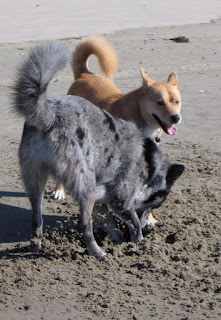
The moment Poppy entered the room where Barley waited, she catalyzed an exothermic chemical reaction: Little Miss Aloof went immediately into Mad Rabbit mode, spinning and cavorting, drawing the dog who'd appeared so anxious five minutes earlier into a bouncing chase over and around the (thankfully well worn) furniture. The two of them were as gleeful as best buddies reunited after a long, regretted absence. They chased, wrestled, and rolled 'til they were both spent, then collapsed panting on the rug, side by side.
And that was that. "Poppy" was a good name for the clown in our new girl, but we thought it might be good to emphasize what was beautiful and steady. Her gorgeous blue merle coat has the same depth of shading you can find in igneous rock, so we decided to name her after a volcano: Kilimanjaro. It suits her in her more majestic moods, and "Kili" can be worn comfortably around the house.
Last summer, after I'd finished a year-long "visit" with the theatre department of a nearby college and determined that academic games weren't the games I wanted to play anymore, I returned to passions I'd long neglected-- for animals and for minds. Combine the two, and you have my undivided attention. I read almost indiscriminately through the lay literature on ethology and animal cognition, hopping here and there and everywhere: Clive Wynne, Mark Bekoff, Donald Griffin, Temple Grandin, Marc Hauser, Robert Sapolsky, etc.
One book I found especially congenial is Franz de Waal's The Ape and the Sushi Master. It seems ridiculous to me that anyone should have to argue for the existence of culture among non-human animals, but because the necessity exists, I'm glad de Waal is around to meet it. He's just able to contain his impatience with his scientific colleagues' irrational terror of anthropomorphism, but he does not shy from pointing out the absurdity of supposing that our capacities for empathy, learning, planning, and creative problem solving arrived from the clear evolutionary blue. Of course it's important to exercise due caution when we try to describe the experience of creatures whose physiology differs markedly from our own, but the significant overlap between my physiology and that of a dog (a not so random example) strongly suggests a significant overlap between our internal experiences. Any refusal to acknowledge this must make a hash of evolutionary theory and its rather ruthless principles of conservation.
The stupidity of denying what we share with "beasts" would infuriate me less if it were consistently maintained as an epistemological problem. This, I think, was Skinner's contention: the tools of science cannot reach interior states. We must confine scientific description to what is directly observable. As an honest assessment of real limits, this kind of rigor is utterly inoffensive. Mark Bekoff says much the same thing: "Feelings do not fit under a microscope." But I think this is where Skinner might have got himself such a lousy reputation among humanists, by his insistence that one should train the same lens on (thinking! feeling!) human subjects as on (reflex-driven! soulless!) rats. His indifference as a scientist to the magnificent embroideries that people sew into the fabric of their observable behavior (everything Freud and Jung pored over and reworked in ever more florid patterns) did not compromise his intellectual project, constrained as it was.
But a scientist who takes the limitations of his discipline and makes them a dividing line between his own richly mysterious, ineluctably individual life and the supposedly simple, mechanical, disposable lives of his subjects has made a grave logical (and potentially moral) error. He wouldn't dare say of other people, "Well, they tell me they feel things, but I can't ever know for sure," though he has no more direct access to their emotions than he has to his dog's. He might argue (sloppily) that language itself makes the difference. Then it is up to him to learn a language not his own. A dog will tell him when it feels joy or pain-- and use consistent, empirically distinct signals to do it-- but only if he cares to listen.
De Waal comments helpfully on the many subtle ways that methodological inadequacies get misread as inadequacies in the subjects of our study: our inability or reluctance to recreate circumstances meaningful to the animals we're observing often results in their fatal lack of interest in the silly tasks we set them to do (fatal to any accurate assessment of their cognitive gifts).
I couldn't imagine how a concern with animals' peculiar (yet familiar) inner lives would entwine with dry, mechanical behaviorism, until I stumbled on Karen Pryor's latest book, Reaching the Animal Mind: Clicker Training and What It Teaches Us About All Animals. The title prominently featured both of my favorite words, and "training" also caught my eye. Our two dogs owed most of the gradual improvements in their manners to the predations of time; they were nearing official status as "seniors," with their eighth birthdays fast approaching. Both had mellowed beautifully, and we'd long since learned to find most of their "misbehavior" charming. Still I wondered whether we might reach a better mutual understanding about paper scraps (which Kili eats compulsively from the street and the dining table) and the dangers posed by cars (if Barley makes eye contact with a friendly-looking driver, she'll run right up, tail wagging).
Reaching the Animal Mind offers both an engaging narrative of Pryor's long experience as a trainer (of dolphins, horses, dogs, people, and fish, among others) and a primer in the principles and methods of what has come popularly to be known as "clicker training" (though it may not involve a clicker in many instances). Finally, it gestures out toward current research in neuroscience that helps explain the method's remarkable efficacy.
 Hops is short for Hopkins, after Gerard Manley Hopkins, who found divinity in the motley and impure.
Pied Beauty
Glory be to God for dappled things--
For skies of couple-colour as a brinded cow;
For rose-moles all in stipple upon trout that swim;
Fresh-firecoal chestnut-falls, finches' wings;
Landscape plotted and pieced-- fold, fallow, and plough;
And all trades, their gear and tackle and trim.
All things counter, original, spare, strange;
Whatever is fickle, freckled (who knows how?)
With swift, slow; sweet, sour; adazzle, dim;
He fathers forth whose beauty is past change:
Praise him.
Our pack (brood? herd? exaltation?) has evolved on the model of "punctuated equilibrium" over the last eight years. Every time things reach a state of relative calm and predictability, we introduce a new variable into the mix. When Barley was eight months old, we knew we weren't yet ready for another dog but thought she'd enjoy a companion more constant and less baffling than her human charges. Well, I thought so. Pete's and my marriage is constructed around a mostly creative tension between my reckless optimism and his crusty "realism." That's what he calls it. As I often perceive it, I propose and he disposes. But the truth is not quite so simple.I'd never had a cat or thought I'd want one. With a few memorable exceptions, I had always found them more irritating than engaging. (There's a reason junior high girls get labeled "catty.") But I'd been hearing from friends that dogs and cats could live together in perfect harmony, even become great friends, if they met early enough in their lives not to notice their differences. At eight months, Barley had already developed a noticeable prejudice against the proposition that cats were people too (she charged them when we encountered them on our walks), but I hoped her young mind (and my old one) remained pliant enough to accommodate a small feline's reality.
Even the county shelter folks get admirably creative around here. When Barley and I were at the nearest dog park one day, an enormous RV pulled into the parking lot, full of animals in need of homes. Where better to find a ready bunch of demonstrated suckers? If it had required any real initiative on my part, I might not have pursued my peaceable kingdom fantasy into the realm of the actual for months, if at all. Cats in the abstract still didn't appeal to me much. But here Barley and I had only to climb a couple of metal steps into a shelter that had come right to us. I walked her (on a very short leash) down a row of cages, thinking that all the hissing and cowering probably didn't bode well for her ability to make friends across the species barrier. Then up to the bars of one cage came a curious little calico, bold as you please. She chirped at Barley, who was momentarily nonplussed but in the next moment sprang up for a closer look, planting both paws on the cage before I could catch her. The kitten took only a half step back and chirped some more. She seemed fascinated. I was charmed. Barley? She had a light in her eyes that I chose to interpret as a desire to know this unaccountably confident creature, not to eat her.
As I drove back home with Barley, I began to assemble my pitch to Pete, but I quickly realized that the kitten could speak much more eloquently for herself. I only told him, "There's someone Barley and I really think you should meet." He was intrigued enough (and indulgent enough of my stubborn fancies) to get in the car and let me drive him back to the park. My work was done. Pete had lived with cats before; he didn't share Barley's and my native mistrust. (I still get freaked sometimes when staring into Hops' alien, snake-slit eyes.) So there was nothing to keep him from falling fast and hard for the patchwork little bundle of impudence who trilled at us from her cage. "Well? Whaddya think?" I asked.
"She's a sweetie," he said. "What should we call her?"

 We'll probably never know for sure. Nic Papalia, who advocates for the maligned dingo back in Australia, didn't think I was crazy when I sent him pictures-- Barley could be a twin to his own lovely (and mordantly named) Lindy.
Nic's dingo gallery
On the one hand, even given the existence of a black market in endangered dingoes, it's really hard to imagine one showing up in a shelter on this side of the Pacific. On the other, Barley performs the part so persuasively-- from her prehensile front claws to the white tip of her tail, from her contortionist's flexibility to her regal independence from human opinion-- that we've never been able entirely to dismiss the possibility. We could send a sample from the lining of her cheeky cheek off to a man at the University of New South Wales who performs genetic testing for conservation purposes, but we'd rather live with this golden dollop of mystery. Barley is our day glow.
The Wiggles sing a dingo tango.
I miss Steve Irwin.
 Our first dog-- first in time, first in line, first in our hearts-- is Barley. Pete and I "rescued" her from a local shelter when she was twelve weeks old, but that's a generous spin on the facts, a rosy way to describe irresistible puppy lust. We came, we saw, we were conquered.
From that very early age, Barley displayed an almost preternatural composure and self-assurance. While a litter of Rottie pups rolled and sprawled and squealed all around her, she sat straight and silent and gave each of us a look that said: Well? Do you want to go through the motions of considering other dogs, or can we cut right to the chase? So to speak.
We went through the motions-- we even put off meeting with her until we had seen a couple of other dogs that actually needed rescuing. But when we could deny our fate no longer, the gal who was helping us led this foxy little miss (absurdly misnamed Angel) into the "getting acquainted" room where we waited on a secondhand couch. She (the foxy pup, not the shelter worker) hopped up between me and Pete and settled into a perfect sphinx pose, with her pristine white paws draped over the cushion's edge.
Done deal. She knew it. We knew it.
They told us "Angel" was a husky-lab-boxer mix, and we had no reason to doubt it until four or five years later, when my grandmother sent me a photo of a New Guinea Singing Dog. Which led me to look at their better known cousins, Australian dingoes. I'd seen images of desert dingoes before and noted only a passing resemblance with our Barley. But when I finally encountered pictures and video of alpine dingoes, my jaw dropped. Could it be?
 Well, hallelujah! Barley and I have made it through our six-month course with the Karen Pryor Academy for Animal Training and Behavior. As I wrote to my sister and brother-in-law this morning, if we hadn't passed our final evaluation last weekend, Barley would have shared in none of the blame, but because we did pass she takes 75% of the credit. Yes, this is the way things tend to go around here, under the reign of the Queen B (or, less formally, Miss B Have), but it's only right. She has been a remarkably patient trainer throughout, teaching me more than I ever could have hoped to learn about communication, collaboration, imagination, and timing. Her willingness to try, fail, fail again, and fail better has inspired me to take more risks in my own learning; I've been continually astonished by her energy and resilience in the face of every new challenge. It's especially impressive when you consider her partner's stubborn clumsiness and frequent stupidity.


